





The Growing Challenge of Textile Waste
The textile sector still runs largely on a linear "extract–make–use–discard" model, and the cost is hard to ignore: over 92 million tonnes of textile waste every year — equivalent to a truckload being landfilled or incinerated every second — while less than 1% is recycled back into new garments. With polyester now accounting for more than half of global fibre use, how textile waste is returned to production has become a fundamental question the industry can no longer ignore.
What turned T2T from research topic to commercial agenda is the EU regulatory timeline. The revised Waste Framework Directive (in force October 2025) introduces the first EU-wide Extended Producer Responsibility (EPR) obligation for textiles, with national schemes due by 2028 and separate collection since 2025. Its pivotal mechanism is eco-modulation — tying EPR fees to durability, recycled content and recyclability, so hard-to-recycle designs pay more and circular-ready ones pay less.
In parallel, the Ecodesign for Sustainable Products Regulation (ESPR) bans large enterprises from destroying unsold garments from 2026, and the textile Digital Product Passport (compliance around 2028–2029) will require QR-code disclosure of composition, origin, chemical compliance and recyclability. All of this applies to any product sold into the EU, regardless of where a brand is based — for Asian supply chains, the countdown has begun.
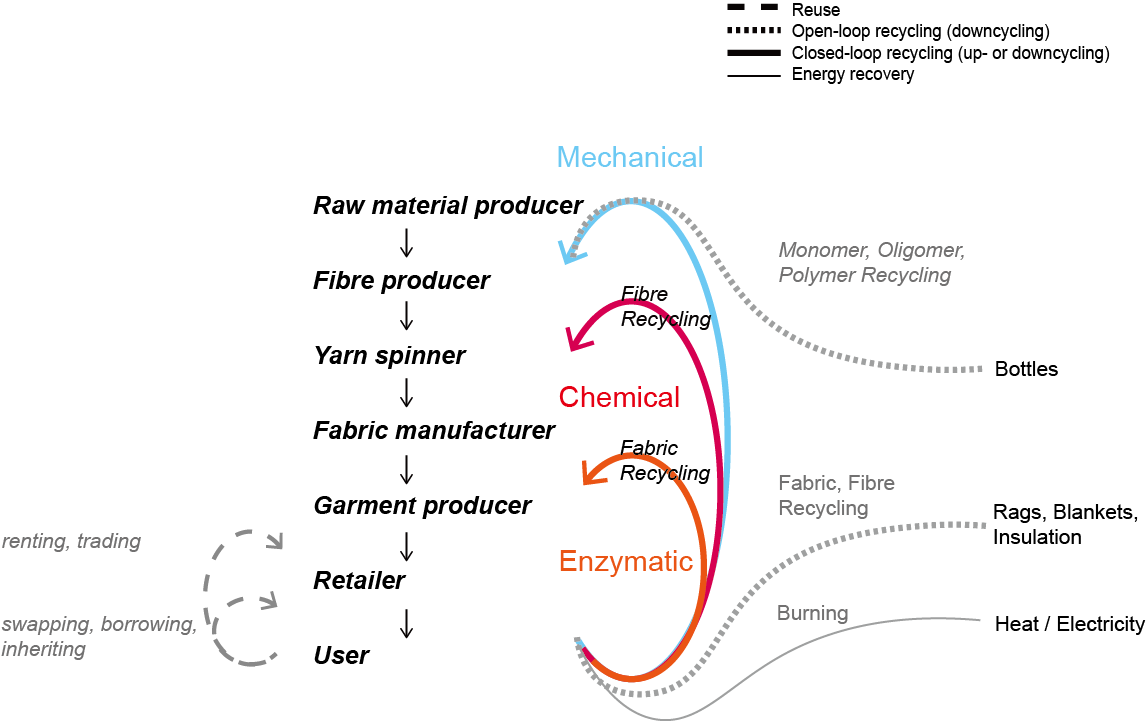
What is T2T? One diagram of the entry points of circularity
Textile-to-textile (T2T), also known as fibre-to-fibre recycling, converts waste textiles into fibres that can re-enter garment production, using physical or chemical technologies. It differs fundamentally from downcycling, where used clothing is degraded into stuffing, rags or insulation. T2T aims to turn yesterday’s garment back into tomorrow’s.
In the value-chain map below, the left column traces the linear flow from raw material, fibre, yarn, fabric and garment through to the user. The most valuable circular loop is reuse, extending product life through renting, swapping and resale.
Once a product genuinely enters recycling, how deeply it is broken down determines where it re-joins the chain: mechanical recycling returns fabric to fibre, while chemical and enzymatic routes can break material down to the monomer level and return it to fibre or even raw-material production, forming a closed loop.
By contrast, open-loop routes into bottles, rags and insulation, and ultimately energy recovery (incineration to heat or electricity), remain value-shedding destinations.
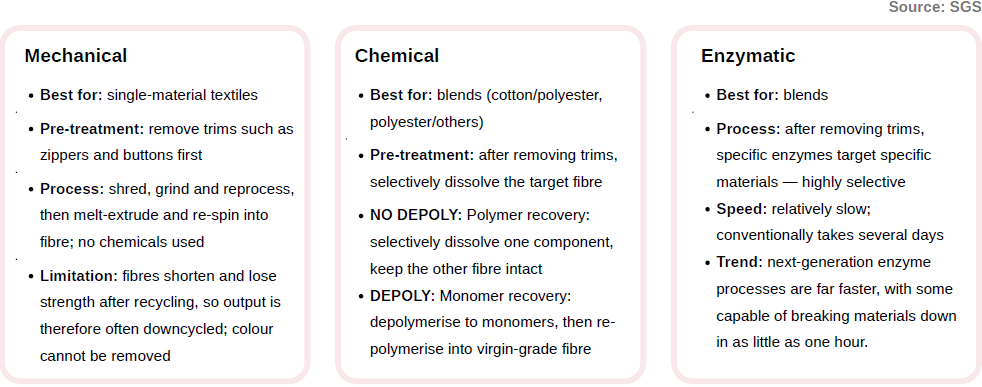
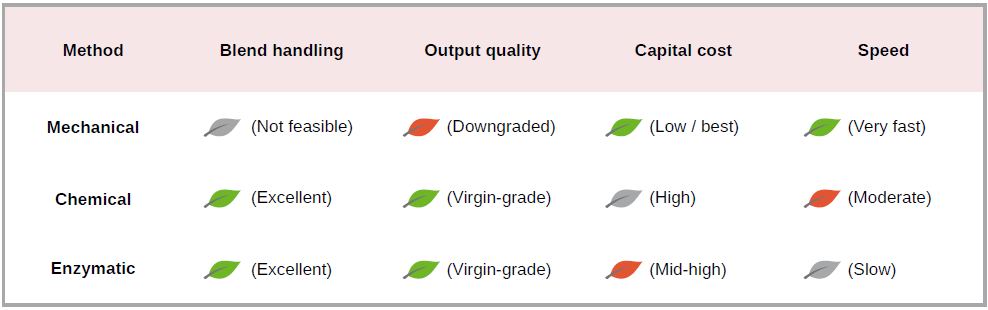
Three Recycling Pathways: Mechanical, Chemical, Enzymatic
T2T is not a single technology but a set of routes defined by the degree to which the material is broken down. The three differ in the materials they suit, output quality, cost, and speed — and understanding those differences is the first step in evaluating any recycled-fibre source.
The Hwafune Perspective
As a Taiwan-based functional textile manufacturer with in-house production, we believe competitiveness in the circular economy begins at the material level—with traceability, thoughtful design, and responsible manufacturing. By integrating fibre selection, finishing technologies, and transparent documentation, we help brands prepare for evolving regulations while delivering high-performance, circular textile solutions.